Freemen's Wood
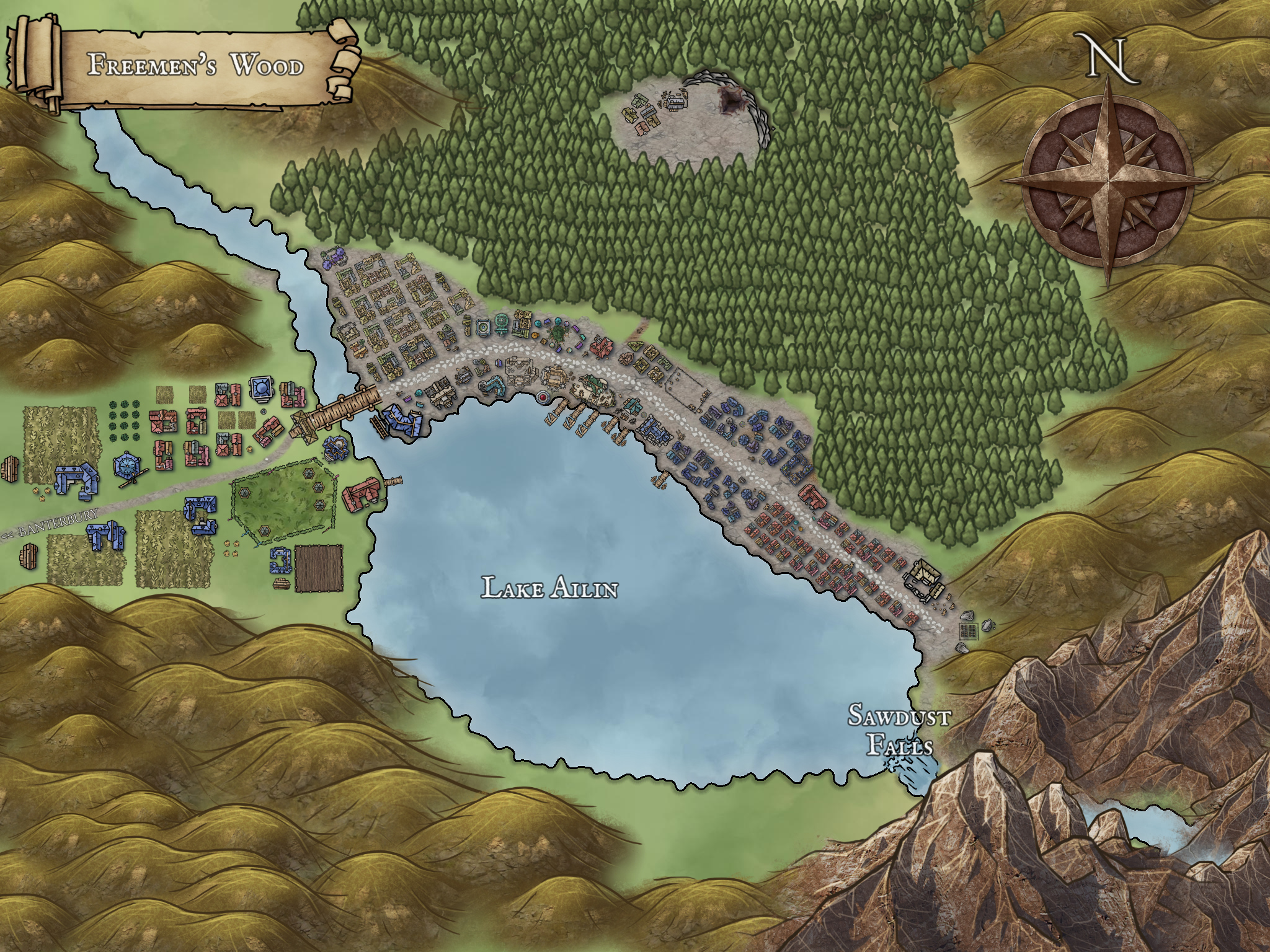
Summary: a nice place to log on
 [Full size](/attachments/FreemensWood.png)
 [Full size](/attachments/FreemensWoodLabeled.png)
## Neighbors
[Full size](/attachments/FreemensWoodLabeled.png)
## Neighbors
- Banterbury, a halfling town
- Fairshore, a halfling town
- Lake Ailin, the local lake
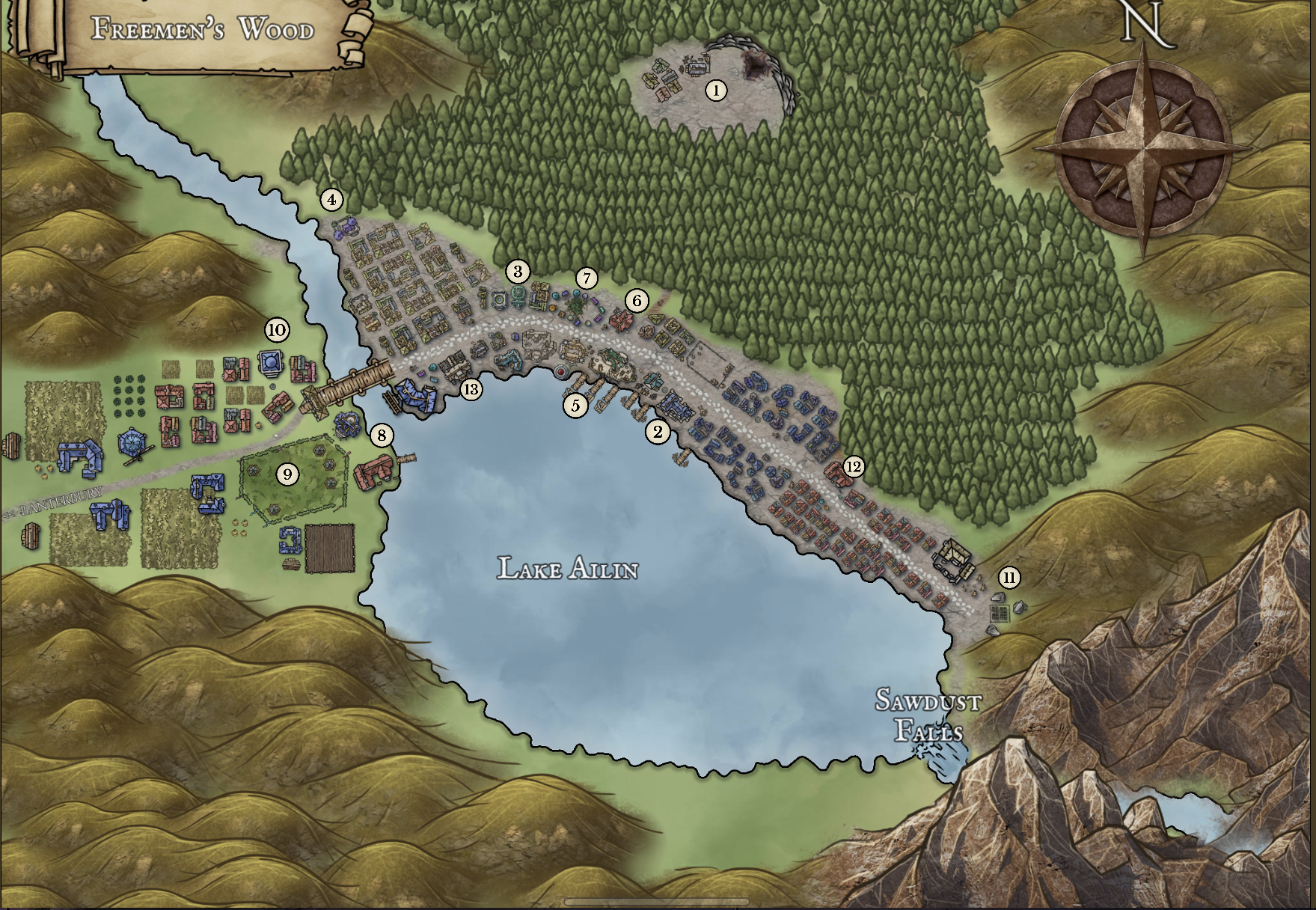
- The Carver’s Hearth (Artisan’s Guild HQ) (13)
- The Copper Exchange
- The Dunleigh Archive (3)
- The Festival Grounds (9)
- The Graveyard (11)
- The Lakeside Inn and theatre (8)
- The Logging Camp and Sinkhole (1)
- The Oakbound Hall (Logger’s Guild HQ) (12)
- The Old Tree Marketplace (7)
- The Raven’s Roost tavern (6)
- The River’s Pact (Rafter’s Guild HQ) (5)
- Town Hall and Public Docks (2)
- The Verdant Glade
- The halfling Temple of Cyrrollalee (10)
- Turahskal Peaks, an impassable mountain range, home to the Orontinórë who dwell in the Valley of Tumbo
- Zephandriel's Tower (4)
NPCs
Notes
Settlers of Freemen’s Wood
Freemen’s Wood was riginally settled by nine families:
- Brennach – From brannach, meaning "raven-haired" or "descendant of a warrior." (Loggers)
- MacRaeghan – A blend of Mac ("son of") and Raeghan ("little king" or "fiery one"). (Rafters)
- O’Dairn – Derived from dair ("oak tree"), symbolizing strength and endurance.(Loggers)
- Kinneagh – From ceannach, meaning "warlike" or "chieftain’s kin." (Rafters)
- Lochlaney – A variation of Lochlann, meaning "of the lake lands" or "descendant of the Norse." (Loggers)
- Tualagh – Based on tuathalach, meaning "of the people" or "lord of the land." (Rafters)
- Finnvara – Inspired by Fionn ("fair-haired") and vara ("watchful" or "guardian"). (Loggers)
- Caerhan – Rooted in caer ("fort" or "stronghold") and han ("descendant of"). (Rafters)
- Dunleigh – From dún ("fort" or "settlement") and leigh ("healer" or "wise one"). (Druid Family)
History
The Founding of Freemen’s Wood
In the beginning, there were the Loggers and the Rafters. They came from The Old Kingdom, pushing into the frontier, seeking fortune and freedom. They passed through the vast, unyielding mountains where they found only hardship—cold weather, sickness, and death. The mountain elves, the Orontinórë, took pity on them, tending to their wounded and sharing the enchanted bounty of their valley. Though no common language bound them, the elves guided the pioneers toward survival.
When the time came to part, the Orontinórë spoke of a lake beyond their lands, a place where the humans could take root. The weary travelers followed the river until they reached its source—a vast, pristine body of water they would call Lake Ailin. There, they built their settlement along the northern shore.
Trade soon flourished. The loggers felled the ancient trees, and the rafters sent them downstream to Fairshore, where the prosperous halflings paid well for good lumber. But as wealth grew, so did resentment. The loggers, who toiled with axe and saw, remained poor, while the rafters, who moved the timber, grew rich. Tensions threatened to splinter the settlement, until Cathbad the Druid intervened. In a sacred ritual of honor and song, he bound the factions together, forging the city of Freemen’s Wood.
A Century of Change
The Rise of Knowledge (Year 20 - 40)
As Freemen’s Wood grew, its children were no longer sent to toil in forest or mines. Instead, a school was founded, ensuring that literacy spread among the people. A grand library was built, its shelves filled with books brought from Fairshore and beyond, while the city’s first paper mill began production, making books and records more accessible. Control of education fell into the hands of a council of scholars, independent from both labor guilds and merchants. With knowledge came opportunity—fewer young people took to logging, and more sought out skills beyond manual labor.
The Artisan’s Awakening (Year 40 - 60)
With literacy came ambition, and with ambition came change. A new district arose—not of loggers or rafters, but of artisans. Woodworkers, sculptors, and furniture-makers transformed raw lumber into fine goods, shifting Freemen’s Wood away from an industry of brute labor to one of craftsmanship. The town gained a reputation for its beautifully carved works—intricate doors, elegant furniture, and even wooden automatons. A cultural shift followed: art was no longer a luxury, but a valued expression of labor. The old guilds resisted, but the tide of change could not be stopped.
To symbolize the city’s evolution, a grand bridge was built over the river, linking the old logger’s district with the growing artisan’s quarter, ensuring that neither side could claim dominance.
New Neighbors and Growing Trade (Year 60 - 80)
Beyond Lake Ailin, a nearby halfling village emerged— Banterbury, a community of farmers who tilled the fertile soil, bringing new agricultural prosperity to the region. This settlement became Freemen’s Wood’s peaceful neighbor, supplying fresh produce, grain, and fine wines in return for lumber and artisan goods. With them came their traditions, including a love of sport and celebration, which found eager adopters among the humans.
Not long after, some of these halflings chose to migrate to Freemen’s Wood, forming their own district within the city. They brought with them a sense of mirth, fine cooking, and a knack for clever tinkering, further diversifying the town’s culture.
The Festival of Song (Year 80 - 90)
With a growing artisan class and a thriving economy, it was only natural that the city sought to celebrate its identity. Thus, the Lakeside Revel was born, an annual event bringing together bards, performers, and artists from across the region. To host it, a permanent fairground was established just outside the city proper, a place for celebrations, trade fairs, and performances year-round.
The festival cemented Freemen’s Wood as a cultural hub, drawing visitors from across the land.
The Land Opens, and the Unknown Emerges (Year 90 - 100)
As the city entered its hundredth year, the land itself shifted. A great sinkhole formed in the forest depression, swallowing part of an old logging camp. At first, it was dismissed as an unfortunate disaster—until things began to crawl out. Strange, eyeless creatures, their bodies pale from ages spent underground, emerged from the depths. Scouts and hunters whispered of tunnels leading deep into the earth, of ancient ruins beneath the surface.
Now, as Freemen’s Wood looks toward its second century, the city faces a new mystery. What lies beneath the land they have claimed? And will the progress they have built survive what lurks below?
Interactions with the Mountain Elves
The Orontinórë send a delegation to Freemen’s Wood every ten years to trade and catch up on their human neighbors. They arrive in late spring, in early Thawtide, and depart in Harvesttide, after Craeftfayre (perhaps after the Autumn Equinox?). Feasts are held to honor the arrival and departure of these honored guests.